Wet Chemistry Laboratory (MECA WCL)
| |
|
|
Previous Next |
|
See also See also
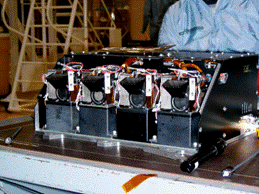
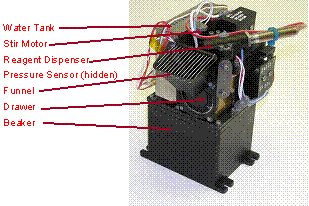
MECA's wet chemistry laboratory (WCL) comprises four single-use modules, each consisting of a beaker assembly and an actuator assembly (figure 1). The modules mix soil samples with a leaching solution in a pressure vessel for electrochemical analysis. The scientific objective of the WCL is to determine the total pH, redox properties, and concentration of the principal aqueously solvated components of the acquired soil samples.
Chemical data is returned by 26 distinct sensors, some redundant, lining the walls of each beaker. These measure: Temperature; pH (3); conductivity; oxidation-reduction potential; the anions chloride (2), bromide, and iodide; cations sodium, potassium, calcium, magnesium; and barium, used in a sulfate titration. Also included are electrodes for cyclic voltammetry, anodic stripping voltammetry, and chronopotentiometry (3). Lithium electrodes (2) are used as a reference relative to the known concentration of lithium salts in the solution. Sensors for nitrate, ammonium, dissolved oxygen and carbon dioxide, which for various reasons do not provide a quantitative measure of soil composition, are used only for context. A heater is imbedded in the base of the beaker to maintain water temperature during operation.
Each WCL actuator assembly includes a tank containing 25-30 ml of a calibration and leaching solution, a sample loading drawer with a capacity of ~1.0 cm3, temperature and pressure sensors, heaters, a stirring mechanism, and a device to dispense up to five small crucibles into the solution. The AA is responsible for soil, water, and solid reagent addition as well as stirring and two-zone internal heating (tank and drawer). Telemetry returned by the AA includes internal cell pressure, water storage tank and sampling drawer temperatures, and certain limit switch positions.
Figure 1. MECA Wet chemistry cells installed in flight enclosure (left) and detail (right)
Each WCL experiment lasts two days, not necessarily sequential. After an initial post-landing checkout, preparation for a chemical experiment starts with melting the frozen leaching/calibration solution in the storage tank and delivering it to the beaker by actuating a puncture mechanism. Sensors are calibrated in that solution, and then calibrated again after addition of a crucible containing small quantities of specific salts. The combined ion concentration from the initial solution and from the crucible, less than 10-4 molar for most ions, establishes the detection floor. The final step is to open the sampling drawer and receive a sample from the robotic arm. The total sample volume is estimated with an accuracy of 0.25 cc (maximum 1 cc) from images acquired by the robot arm camera. For the remainder of the day, the concentration of major anions and cations are monitored as well as key indicators such as pH, redox potential, and cyclic voltammetry, stirring when appropriate and maintaining a constant temperature of 5C. At the end of the day the solution is allowed to freeze in the beaker. A second day of measurement begins with thawing of the solution in the beaker, determining the sensor baseline, and adding an acid-containing crucible to lower the pH. Monitoring continues as on the first day. The final activity is the sequential addition of three crucibles of barium chloride. A sulfate titration is performed by monitoring the barium and chloride levels as the crucible contents slowly dissolve.
Most sensors will have three separate calibration steps prior to their use on Mars. Each individual electrochemical sensor was first calibrated prior to integration into the beaker by laboratory measurement in several standard solutions using commercial electronics. The second calibration was performed with the same solutions after beaker integration, using flight-like analog electronics and a laboratory digital controller. The exceptions were the bromide and iodide sensors, which could not be tested after integration without contaminating the chloride sensor. The final two-point calibration will occur on Mars. In general, the ion selective electrodes exhibit classic logarithmic Nernstian behavior over the specified measurement range. While the two-point calibration will be used to determine logarithmic slope and zero offset, the laboratory data suggests that it is sufficient to assume the ideal Nernstian slope and correct only the offset.
Pre-amplifier circuitry for the electrochemical sensors is embedded in the beaker walls. Analog to digital conversion (12-bit) is performed on a heavily-multiplexed "Analog Board" which interfaces to an FPGA on the primary MECA control and measurement electronics (CME) board. The FPGA also generates waveforms for the voltammetric and potentiometric sensors, performs temperature control, and operates actuators. Also returned in telemetry is a reading from an external temperature sensor located on the base of the microscopy sample stage.
Source: MECA Non-Imaging EDR SIS |